Away from the "sunny showroom" default
For years, the default exterior render was the same image everyone has now seen a thousand times: flat blue sky, midday sun straight overhead, a lawn a little too green. It was never wrong exactly, but it’s become instantly recognizable as generic marketing rather than a specific, believable place — and buyers who’ve scrolled past hundreds of near-identical listings notice the sameness even if they can’t name it. The clearest shift going into 2026 is away from that generic default and toward images that read as a photograph of one particular building on one particular day, not a template with a new facade dropped in.
Golden hour, blue hour, and light with a direction
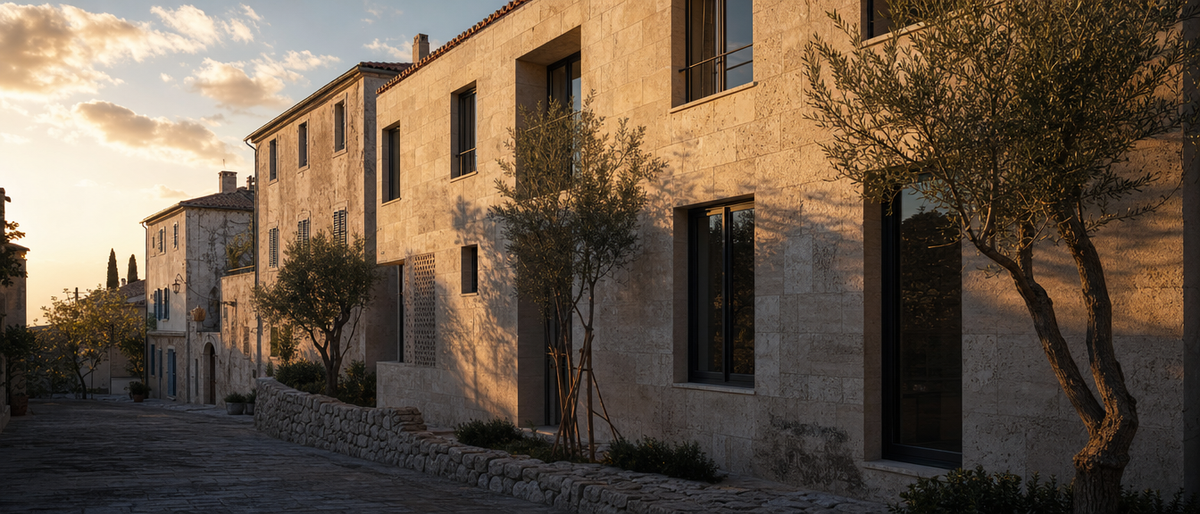
Flat midday light is being replaced by light that has an obvious direction and story — long, warm shadows raking across a facade in late afternoon, or a dusk shot where the sky still holds colour while interior lights are already glowing through the windows. A building lit this way reads as lived-in and specific rather than staged; the same facade shot at flat noon can look correct but curiously inert by comparison. Night and dusk renders in particular have moved from an occasional add-on to a standard part of an exterior set, precisely because interior glow against a darkening sky does more to suggest a home people actually want to be in than a bright daytime shot ever fully manages.
Materials and landscaping that name a place
Generic-looking stone, generic timber and a generic lawn all say the same thing: this building could be anywhere. The trend for 2026 leans the opposite way — materials and planting chosen to actually match the region and climate a project sits in, with the kind of age and wear real materials pick up over time rather than a uniformly "new" finish. The same logic applies to landscaping: a mix of plant species suited to the real site, rather than one tree model repeated at even intervals, does more to convince a viewer the scene is real than almost any lighting trick.
Framing that feels observed rather than staged
Renders are trending toward framing that feels like it was found rather than arranged — a slightly off-centre angle, a wider establishing shot paired with a tighter, more human-scale detail shot of the same building, context (a neighbouring building, a street, weather) left visible rather than cropped out to isolate the architecture in a vacuum. We go through the composition fundamentals behind this — camera height, framing, depth of field — in our piece on what separates professional renders from amateur ones; the trend here is really about applying that same discipline to tell a more specific story about one building, rather than a generic "hero shot" of any building.
Real-time review, not just finished stills
Clients increasingly expect to walk through a project in a real-time engine before committing to a final set of stills, rather than waiting on a handful of pre-baked images and requesting changes blind. That shift is one of the reasons we build on Unreal Engine alongside Blender and Cycles — it lets a client see lighting, materials and camera angles change live in a review session, and lock in the exact frame worth spending render time on, instead of guessing at it from a written brief alone.
Generative AI as a moodboard, not a shortcut
The other real shift is earlier in the process rather than in the final image: generative AI tools are now a genuinely useful way to explore lighting directions, material palettes or a general mood in minutes rather than hours, before a full scene gets built. That’s a meaningfully different use of AI than generating a "finished" image — the final render is still built from the actual model, actual materials and actual light simulation, because that’s what makes it a reliable stand-in for the real building rather than a rough impression of one. Used this way, AI compresses the exploration phase; it doesn’t replace the render.
What doesn’t change?
None of these are stylistic trends layered on top of guesswork — they’re stylistic choices layered on top of the same fundamentals that separate convincing work from amateur work regardless of the year: light that behaves correctly, materials that read as honest rather than generic, and composition that makes a deliberate choice about where the eye goes. Get in touch if you’re planning an exterior set for 2026 and want to talk through which of these actually fits your project.