A room full of people who aren’t deciding whether to buy
Visualization for a school, a stadium, a cultural center or a piece of public infrastructure is presented to a completely different audience than a residential or commercial project — a planning council, a jury, and the residents who’ll actually live next to it. None of them are deciding whether to purchase a unit. They’re deciding whether to approve something that will permanently change a place they already know. That shift in audience changes what a "convincing" image actually needs to do: less lifestyle aspiration, more honest, defensible information.
Why does an ordinary Tuesday sell more trust than a hero shot?
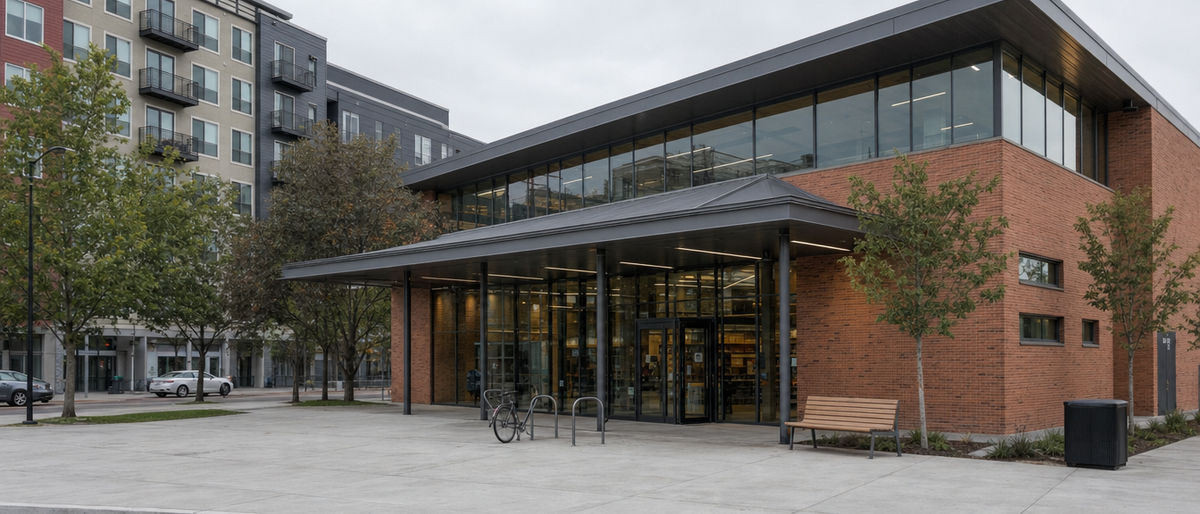
Residential marketing leans hard on the golden-hour hero image — the building at its most flattering possible moment. That instinct works against you in front of a skeptical public audience. A council member or a nearby resident isn’t trying to picture the building on its best day; they’re trying to judge how it will actually look and function most days, and an overly idealized image can read as evasive at exactly the moment trust matters most. The stronger approach usually pairs a handful of ordinary, everyday scenarios — overcast light, normal foot traffic — with the ceremonial moments that genuinely matter: a graduation on the school lawn, match day at the stadium. Showing both is what makes either one credible.
Context is the entire argument
Civic approval turns almost entirely on how a building sits inside a place people already know — sightlines from existing homes, whether a new structure’s shadow falls across a neighbor’s windows, how it changes pedestrian and traffic flow, its scale next to what’s already there. That’s the opposite instinct from most marketing renders, which isolate the hero building against a clean backdrop. Here, the surrounding context has to be rendered with as much care as the new structure itself, because the context is usually what the hearing is actually about.
Defusing the objection before it’s spoken out loud
Most opposition at a public hearing comes from a specific, nameable worry — a shadow on a particular window, a traffic bottleneck at school pickup time — and a clear image that honestly answers that exact worry does more to defuse it than any verbal reassurance could, simply because it lets people see for themselves instead of taking a developer’s word for it. That also raises the stakes on honesty: an overly flattering civic render that doesn’t match what actually gets built damages public trust in a way that’s much harder to recover from than a disappointed buyer, because the institution behind it has to keep working with the same community afterward.
Where this fits
This is its own discipline within visualization — schools, stadiums, cultural centers and infrastructure, built for both the everyday scenario and the ceremonial one, for juries and communities rather than buyers. Get in touch if you’re bringing a public or civic project to a hearing and want visuals built for that specific room.