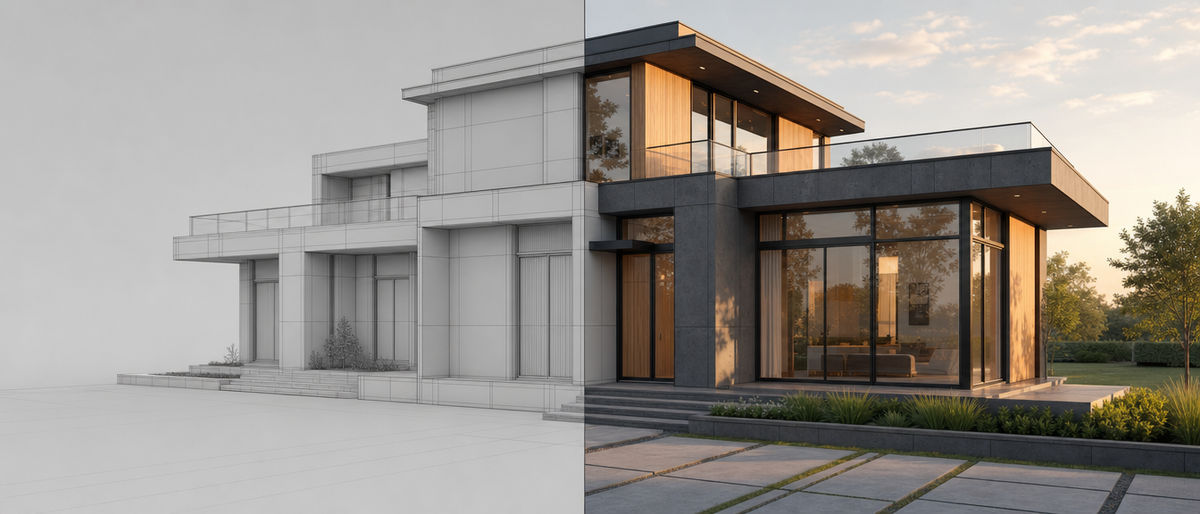
Two different jobs, not two competing tools
Every marketing brief for a development eventually runs into the same question: shoot it, or render it? Framed that way, it sounds like a taste decision — a house style, a budget line. In practice it isn’t a preference at all. It’s a question about where the project actually is in its life, because a camera and a render engine are built to do two entirely different jobs, and only one of them is available at any given stage.
What each medium is actually built for
Photography documents something that already exists. Its production is linear and tied to the physical world: pre-production, a shoot day with crew and equipment, then retouching. That dependency is also its biggest constraint — it needs finished construction, the right weather, and staged furniture in the room, and once the shutter closes, any change (a different facade colour, a different season) means booking an entirely new shoot from scratch. There’s no revision flexibility once the image exists.
CGI constructs an image before the thing physically exists. Once a digital scene is built, generating a different angle, season, lighting condition or finish option is a render setting, not a new production. That’s the whole reason it exists as a category: it’s the only tool that can sell a building while it’s still a hole in the ground. We’ve covered exactly how that scene gets built — the seven-stage pipeline, the software, the hardware — in our deep dive on the architectural visualization process; this piece is about when to reach for it, not how it’s made.
Matching the tool to where the project actually is
At concept and pre-construction, there’s only one option: the building doesn’t exist yet, so CGI carries the entire visual conversation with investors, planners and first buyers.
During active construction and off-plan sales, renders hit their highest return. A construction site sells nothing — it’s scaffolding, mud and concrete. Every pre-sale in this window is being carried entirely by the quality of the visualization, which is why this is the stage developers invest in it most heavily.
At handover, photography starts to earn its place back — a real photo of a real, finished building is proof a developer delivered, in a way no render can substitute for. Empty, undressed units at this stage are usually better served by virtual staging — real photography of the finished shell with furniture composited in digitally — than either a full CGI scene or a full physical staging budget.
After the building is occupied, lifestyle photography and film take over: the goal shifts from selling square meters to building the developer’s brand equity, and that reputation is exactly what makes the next paper project easier to presell with CGI. The two mediums aren’t really competing within one project — they hand off to each other across a developer’s whole portfolio.
Which tool wins at each stage
| Project Stage | Best Tool | Why |
|---|---|---|
| Concept / pre-construction | CGI (only option) | The building doesn’t exist yet — CGI carries the entire visual conversation with investors, planners and first buyers. |
| Active construction / off-plan sales | CGI (highest ROI) | A construction site sells nothing — scaffolding, mud, concrete. Every pre-sale in this window is carried entirely by the visualization. |
| Handover (finished, unsold or empty units) | Photography for proof of delivery, virtual staging for empty units | A real photo of a real, finished building proves a developer delivered — no render can substitute for that. |
| Post-occupancy | Lifestyle photography and film | The goal shifts from selling square meters to building brand equity, which makes the next paper project easier to presell with CGI. |
Why does CGI scale while photography doesn’t?
The clearest way to see the economic difference is to ask what it costs to produce one more variation. For photography, that cost is close to linear — three finish options mean three physical setups, three crews, three shoot days. For a rendered scene, once the digital twin exists, an additional angle, a different season on the same facade, or an alternate material palette is a render job, not a new production. That’s why CGI’s heaviest cost sits at the start (building and lighting the scene) while every asset after that gets cheaper — the opposite curve to photography, where every new variation costs roughly what the first one did. We go through the actual sales-velocity and price-premium numbers this produces in our piece on the ROI of 3D visualization.
Where photography still wins
None of this makes CGI a universal replacement. Photography still carries real advantages that no rendering pipeline has fully closed.
Trust is the biggest one — a real photo of a real building is the clearest possible proof that what was promised got built, and buyers weigh that kind of evidence differently than a render, however accurate.
Human presence is a genuine limitation for CGI. Rendered or composited people can read as slightly stiff — a kind of uncanny-valley effect where the scene is otherwise photoreal but a figure’s posture or expression breaks the illusion. Candid, unscripted human moments are still something only a camera reliably captures.
And real materials carry small, unplanned imperfections — dust catching a light beam, a slightly uneven fold in heavy curtain fabric, the way sunlight actually behaves at a location that day — that a perfectly clean render can accidentally miss. In texture-heavy, close-up shots especially, that "too-perfect" quality is sometimes exactly what tips a viewer off that they’re looking at a CGI image rather than a photograph.
The practical takeaway
Most developers don’t really choose between CGI and photography once, at the start of a project — they choose per stage. CGI does the selling-before-it-exists work; photography does the proving-it-exists work; virtual staging bridges the gap between them. Our part of that lifecycle is the CGI half — the digital twin that takes a project from a set of drawings to a committed buyer — and it’s built to hand off cleanly the moment there’s something worth pointing a real camera at. Get in touch when you want to see that applied to your project.